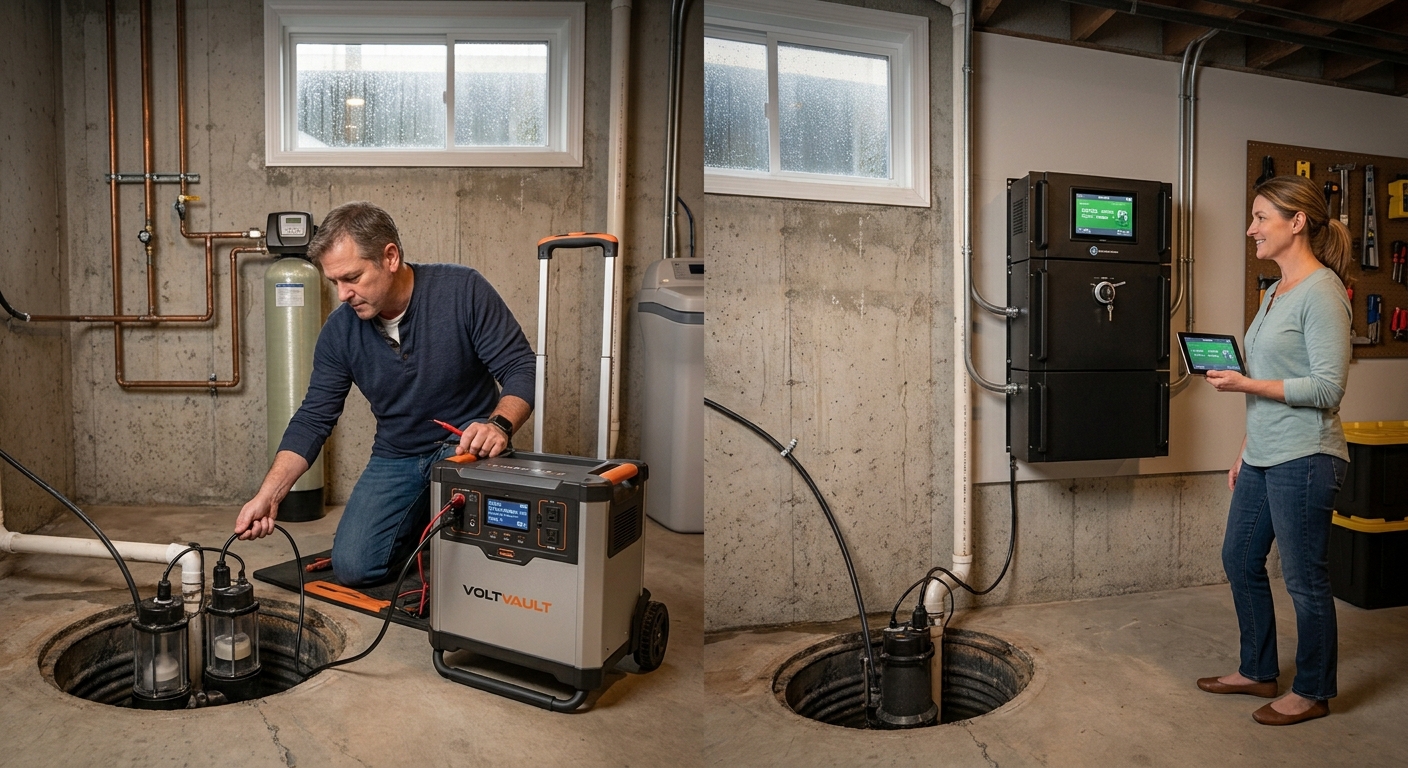
Nothing ruins an outage faster than a flooded basement. Sump pumps are one of the few appliances where losing power for even a few hours can turn into thousands of dollars in water damage — which is exactly why «will my backup power option actually run my sump pump?» is one of the most important questions a homeowner can ask before a storm, not during one.
There are two fundamentally different ways to keep a sump pump running when the grid goes down: a dedicated sump pump battery backup system (a purpose-built unit like a Basement Watchdog, wired permanently into your sump pit) or a general-purpose portable power station (a Jackery, EcoFlow, Bluetti, or similar unit you plug the pump into during an outage). Below, we break down how each one actually works, what the wattage math looks like, and which setup makes sense for your situation.
This article contains affiliate links. If you buy through one of them, we may earn a small commission at no extra cost to you — see our affiliate disclosure for details.
How Dedicated Sump Pump Battery Backups Work
A dedicated system, like the Basement Watchdog Special or similar products from other brands, is installed directly in your sump pit alongside (or as an upgrade to) your existing AC-powered pump. It runs on its own deep-cycle battery, sits there fully charged at all times, and switches on automatically the moment it detects a power outage, a primary pump failure, or water rising faster than the main pump can handle. Most models include 24/7 monitoring, an audible alarm for battery or pump problems, and in some cases WiFi alerts to your phone.
The key advantage is that it’s a single-purpose appliance: it doesn’t need to be found, carried, or plugged in during an emergency. It’s already there, already wired, and already tested for exactly this job.
How a Portable Power Station Handles a Sump Pump
A portable power station takes a different approach. Instead of being purpose-built for the pump, it’s a general battery-and-inverter unit that you connect to the pump’s existing power cord (via an extension cord or, in some setups, by wiring it into a transfer switch) when the power goes out. The same unit can also run your fridge, lights, and phone chargers — which is the main appeal.
The catch is that sump pumps are a genuinely demanding load for a general-purpose power station, for one specific reason: startup surge.
Why Startup Surge Is the Whole Ballgame
Sump pump motors are induction motors, and induction motors draw a short spike of power — often two to three times their steady running wattage — the instant they switch on. A pump that only draws 750W while actively pumping water can demand a startup surge of 1,800W or more for a fraction of a second. If your power station’s surge rating doesn’t clear that spike, the unit will trip its internal protection and shut off — and your pump simply won’t start, even though the power station looked «big enough» on paper.
Rough figures by pump size (these vary by brand and model, so check your pump’s nameplate or manual for exact numbers):
| Pump Size | Typical Running Watts | Typical Starting (Surge) Watts |
|---|---|---|
| 1/3 HP | 200–400W | 800–1,500W |
| 1/2 HP | 300–500W | 1,300–2,200W |
| 3/4 HP | 400–600W | 1,800–2,500W |
| 1 HP | 800–1,800W | Up to 5,400W |
The rule of thumb: check the pump’s surge rating, not just its running wattage, and make sure your power station’s surge capacity clears it with room to spare. A power station rated for 2,000W continuous output but only 3,000W surge may still be underpowered for a 1 HP pump.
Runtime: The Second Half of the Equation
Once the pump has started, the second question is how long your power station can keep feeding it. Sump pumps don’t run continuously — they cycle on and off as water enters the pit — so runtime depends heavily on how much rain is falling, not just the pump’s wattage.
A simple way to estimate it: battery Wh × 0.85 (real-world efficiency) ÷ pump running watts = hours of active pumping time. But because pumps cycle rather than run continuously, the number that actually matters is how many minutes per hour the pump is active, which can range from a couple of minutes during light rain to running almost continuously during a major storm. A power station that comfortably lasts a full day of light, intermittent cycling might only last a few hours if the pump is running nearly nonstop during a heavy downpour.
Side-by-Side Comparison
| Dedicated Battery Backup System | Portable Power Station | |
|---|---|---|
| Activates automatically | Yes, built-in float switch and controller | Only if wired through a transfer switch or UPS-style auto-switchover; otherwise manual |
| Purpose-built for pump surge | Yes | Depends on model — must be checked against pump specs |
| Also powers other appliances | No, single-purpose | Yes — fridge, lights, devices, medical equipment |
| Monitoring / alerts | Often includes battery and pump health alarms, some with WiFi notifications | Usually app-based battery monitoring only, not pump-specific |
| Installation | Permanent, wired into the pit and plumbing | Portable, no permanent installation required |
| Typical cost | $150–$400 for the unit, plus a separate deep-cycle battery | $500–$2,000+, but reusable for whole-home backup, camping, etc. |
| Best for | Homes where basement flooding is the single biggest risk | Homes that want one flexible unit covering the pump and everything else |
Which One Should You Actually Get?
Choose a dedicated battery backup system if: basement flooding is your primary, specific risk (you live somewhere prone to heavy rain, have a finished basement, or have had water damage before), and you want something that works automatically without you needing to be home, awake, or thinking about it when the power drops at 3 a.m.
Choose a portable power station if: you want a single, flexible backup solution that covers the sump pump and your fridge, WiFi, medical devices, and lighting during a broader outage — and you’re willing to do the wattage homework up front (and ideally test it on your actual pump before storm season) to confirm your unit can handle the startup surge.
Consider both if: flooding risk and budget allow it. Many homeowners run a dedicated battery backup as the automatic first line of defense for the pump specifically, with a portable power station as the broader whole-home backup for everything else. That combination avoids putting all your eggs in one basket — if the dedicated backup’s battery is old or undercharged, you still have a second option.
Safety Notes Before You Rely on Either System
- Test before the storm, not during it. Run your pump on battery power (dedicated system or power station) as a dry run before hurricane or storm season, not for the first time during an actual flood risk.
- Verify surge rating against your specific pump, not a generic average — check the nameplate on your pump or its manual for exact running and starting watts.
- Keep any power station in a dry, elevated location, away from the sump pit itself, and use a properly rated, undamaged extension cord if it isn’t hardwired in.
- A backup battery degrades over time. Whether it’s a dedicated system’s deep-cycle battery or a power station’s internal battery, check charge level and battery health periodically — a backup that hasn’t been tested in two years is a gamble, not a plan.
- If you’re unsure about wiring a power station into a transfer switch or your sump pump’s circuit, have a licensed electrician confirm the setup rather than improvising during a storm.
Frequently Asked Questions
Can any portable power station run a sump pump? Not automatically — it depends entirely on whether the unit’s surge output rating exceeds your specific pump’s starting wattage. A pump that seems modest on running watts alone can still trip an underpowered inverter at startup.
Do I need a transfer switch for a sump pump and power station? Not necessarily. Many homeowners simply plug the pump’s cord into the power station during an outage. A transfer switch is more relevant if you want the power station wired into your panel for automatic switchover across several circuits, not just the pump.
Is a dedicated sump pump battery backup enough on its own? It protects against basement flooding specifically, but it won’t power your fridge, lights, or anything else in the house. If the outage stretches beyond a few hours, most homeowners want broader backup too.
How often should I replace the battery in either system? Dedicated systems typically use lead-acid or AGM batteries that are commonly rated for a few years of standby use and should be tested regularly; check your specific model’s manual. Power stations using LiFePO4 batteries generally hold up for several thousand charge cycles, but battery health is still worth checking each storm season.
The Bottom Line
A dedicated sump pump battery backup is the more «set it and forget it» option for the single risk that matters most — a flooded basement — because it activates automatically and doesn’t require you to do anything at the moment it counts. A portable power station is the more flexible option, doing double duty for your whole household’s backup needs, but only if you’ve confirmed in advance that it can actually clear your pump’s startup surge. For homes where flooding is a serious risk, running both isn’t overkill — it’s redundancy where redundancy actually matters.
Always check your specific sump pump’s running and starting wattage — printed on the pump’s nameplate or listed in its manual — before choosing a backup power source, and test the full setup before you need it.